
2026 Palm Oil Mill Equipment Purchase List & Selection Complete Guide
With the continuous growth of global palm oil market demand, building and upgrading palm oil pressing plants has become a high-value investment for oil processing enterprises and agricultural investors worldwide. Different from conventional oil crops, palm fruit (FFB) processing features high temperature, high humidity and high fiber content, which puts forward stricter requirements on processing equipment.
Faced with diverse equipment on the 2026 market, scientific equipment selection and standardized procurement planning are the core factors that determine plant operation efficiency, oil yield and long-term profitability. This article sorts out the full set of palm oil mill core equipment list, supporting system configuration and professional selection strategies, providing reliable reference for global investors and factory builders.
1. Core Process Equipment: Core Foundation of High Oil Yield
The palm oil pressing process directly determines crude palm oil quality and final output. The complete production line covers sterilization & threshing, digestion & pressing, crude oil clarification three core links, with matched professional equipment as follows:
1.1 Sterilization & Threshing System
Fresh palm fruit bunches contain active enzymes, which will cause a sharp rise in Free Fatty Acid (FFA) and lead to oil rancidity without timely treatment. Sterilization and threshing are the primary pretreatment procedures to guarantee oil quality.
Sterilizer: The key pretreatment equipment, available in horizontal and vertical types. It adopts 130-145℃ high-pressure saturated steam to treat FFB for 60-120 minutes, which completely inactivates active enzymes to avoid rancidity, softens pulp and loosens shells, effectively improving the subsequent oil yield.
Thresher: Professional equipment for separating palm kernels from empty fruit bunches (EFB). Equipped with high-speed rotor and mechanical beating device, it can adjust material conveying speed accurately, realizing high-efficiency separation while protecting fruit integrity and reducing kernel damage.
1.2 Digestion & Pressing System
This link is the key to breaking pulp cell walls and maximizing oil release, deciding the pressing efficiency fundamentally.
Digester: It heats and humidifies separated palm fruits. The internal high-speed blades crush pulp into paste, and constant steam heating at 60-80℃ completely destroys cell wall structures, creating optimal conditions for grease precipitation and pressing.
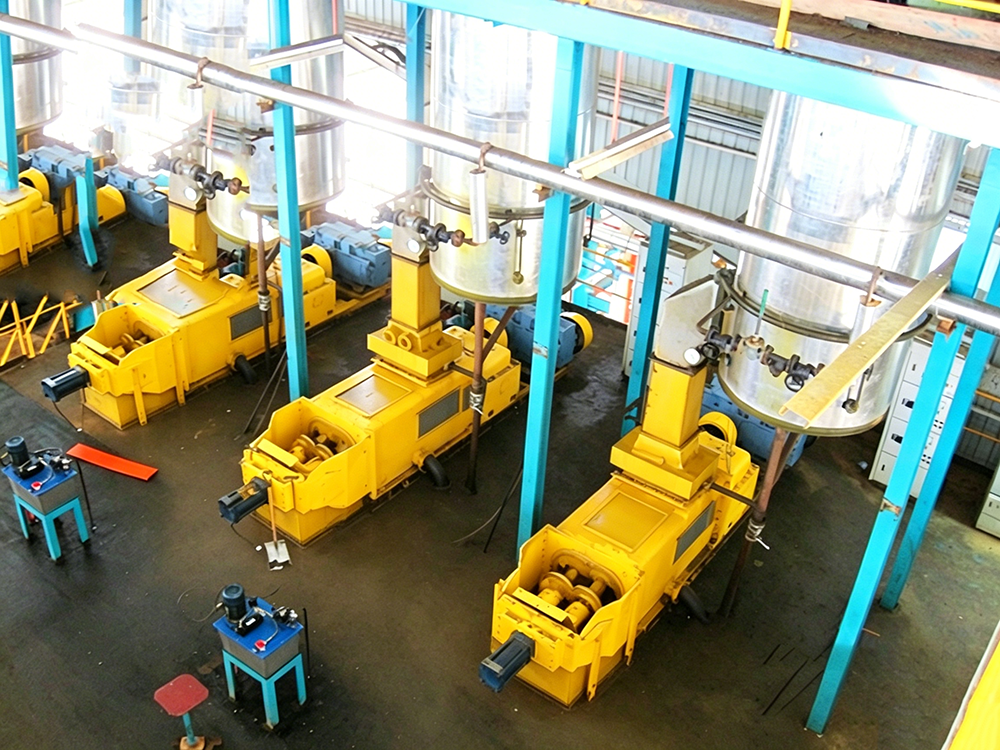
Double Screw Palm Oil Press Machine: The core equipment of the entire production line. Suitable for medium and large-scale automated production. It works stably at 70-90℃, with adjustable screw speed (20-30rpm) and compression ratio (5:1 to 10:1). It features low residual oil rate, less broken kernels and low residue, ensuring high oil yield and stable oil quality.
1.3 Crude Oil Clarification System
Freshly pressed crude palm oil contains moisture, fiber, sediment and other impurities, which are easy to deteriorate. Clarification and dehydration are essential for oil preservation and quality upgrading.
Vibrating Screen & Multi-stage Clarification Tank: The vibrating screen removes large-particle fiber impurities first; the multi-stage clarification tank realizes preliminary oil-water separation by specific gravity difference.
Vacuum Drying Equipment: Eliminates excess moisture absorbed during sterilization and digestion. It effectively prevents crude oil rancidity and extends oil storage life, being a necessary device for standardized palm oil production.
2. Auxiliary Supporting System: Ensure Stable & Efficient Operation
A complete auxiliary system is indispensable for modern automated palm oil mills, realizing low-consumption, continuous and environmentally friendly production.
2.1 Material Conveying System
Aiming at the characteristics of heavy weight and high fiber of palm materials, matched conveying equipment realizes automated material handling, reducing labor cost and material loss. Main equipment includes scraper conveyor (horizontal conveying), bucket elevator (vertical lifting), screw conveyor and air compressor.
2.2 Intelligent Electrical & Control System
2026 new upgraded intelligent control configuration. Equipped with PLC automatic control system, high-precision sensors, high-quality motors and reducers, it realizes real-time monitoring and automatic adjustment of pressing temperature, pressure and torque. It reduces manual intervention, avoids unplanned shutdowns and ensures consistent product quality.
2.3 Environmental Protection & By-product Utilization System
Modern palm oil production must comply with global environmental standards and realize circular economy.
Biomass Boiler: Takes EFB and palm fiber residues as fuel to generate steam and power. It meets the factory’s self-energy demand, greatly reduces operating costs and realizes full utilization of by-products.
Wastewater Treatment Equipment: Targeted at high-concentration wastewater from palm oil processing, it meets local international environmental discharge standards, realizing green and sustainable production.
3. 2026 Palm Oil Equipment Selection & Procurement Core Strategies
Reasonable equipment selection matching project positioning is the key to avoid blind investment and improve return on investment (ROI).
3.1 Match Equipment Capacity with Plant Scale
For small and medium-sized factories and overseas new projects: prioritize skid-mounted and modular integrated equipment. It covers small area, features fast installation and quick commissioning, greatly shortening construction cycle.
For large-scale production lines (above 30 tons/hour): focus on equipment corrosion resistance. Key parts adopt 316L stainless steel to adapt to high-temperature and high-humidity working environment, extending equipment service life.
3.2 Prioritize Energy Efficiency & International Certification
Under global dual-carbon policies, high-energy-consumption equipment is gradually phased out. It is recommended to select equipment with energy-saving heat exchangers and efficient purification systems to reduce unit production energy consumption.
Meanwhile, verify ISO 9001, CE, MSPO and other international certifications. Certified equipment meets global market access standards, facilitating subsequent product export and market expansion.
3.3 Focus on After-sales Service & Localized Support
Palm oil mill equipment runs under long-term high-load conditions, making after-sales support critical. When purchasing, clarify warranty period, spare parts supply cycle and on-site technical training services.
Choose suppliers with overseas service networks, multi-language operation manuals and 24-hour remote diagnosis support to guarantee long-term stable operation of the production line.
4. Summary
Scientific palm oil mill equipment procurement and selection are the core of improving production efficiency, oil yield and economic benefits. Starting from core process equipment, supporting systems and targeted selection strategies in 2026, investors can avoid invalid investment, realize standardized, intelligent and environmentally friendly palm oil production, and gain stable profits in the global palm oil market.